
How to regulate your emotions in a simple way, by an experienced professional
As a clinical psychologist, I tend to work in a fairly directive way. Many of the people I work with don’t want to spend months just talking about the same problem. Instead, they want to understand what’s not working and what they can actually do about it.
Over the years, I’ve collected a number of practical tools that I use depending on the situation each client is facing. One of the most common problems I see in therapy (regardless of the diagnosis) is difficulty regulating emotions.
People often try to solve emotional problems by thinking more, avoiding more, or distracting themselves, but very rarely are they taught how to actually process an emotion. And this is where a simple exercise can make a big difference.
What Is Emotional Regulation (and What It Is Not)
Emotional regulation is a term that has become more and more popular over time (even big unis are talking about it), but it is often misunderstood. Many people think emotional regulation means controlling emotions, suppressing them, or trying to calm down as quickly as possible. In reality, emotional regulation is something different. I’ll give a clear-cut definition here:
Emotional regulation is the ability to experience an emotion just enough so that your mind and body can process them, while still being able to continue with your daily life: working, studying, spending time with people, relaxing, and sleeping. This way the person doesn’t either disconnect from emotions or get overwhelmed by them. By doing this, the person is able to properly process and release things as they show up, strengthening the self and avoiding all the issues that come with being pent up (e.g. extra stress, too much tension, anger outbursts, panic attacks, etc.)
In What Situations Do People Struggle With Emotional Regulation?
Difficulties with emotional regulation show up across many common psychological problems. For example:
- Anxiety and chronic worry
- Overthinking and rumination
- Depression
- Anger and irritability
- Relationship conflicts
- Breakups and grief
- OCD and intrusive thoughts
- Stress and burnout
- Shame and self-criticism
In many of these situations, something key happens. The mind learns, usually without the person realizing it, that instead of using the emotional system to actually process emotions, it’s more efficient to rely on escape mechanisms. Ways to avoid feeling things that are too uncomfortable, too confusing, or simply too overwhelming. This is usually because the person wasn’t properly taught how to be efficient at dealing with their own mood changes and how to stabilize on their own.
So sometimes this escape looks like avoidance: not talking about certain things, distracting yourself constantly, working too much, staying glued to your phone, or keeping yourself busy from morning to night so you never have to stop and actually feel things.
But many times, instead of escaping outright, the wrong system gets recruited: the rational mind.
Now don’t get me wrong: The rational mind is genuinely useful, and good at what it does. Work problems, financial decisions, planning, studying… these are its territory. I usually work with guys who have very developed rational minds and reap the benefits from that (successful investors, doctors, lawyers). But when the rational mind tries to solve an emotional problem, now that’s different. It’s like trying to lsiten to a song using your eyes instead of your ears. People get stuck in overthinking. They analyze everything. They search for the perfect explanation, replay conversations on a loop, run through different scenarios, and try to intellectually “figure out” how to feel better.
The main problem is that this burns through enormous amounts of time and mental energy, and it almost never resolves the emotional problem underneath. If anything, it keeps people circling the same territory without ever landing anywhere.
What tends to follow is a particular kind of exhaustion. Not physical tiredness, but the mental kind. An inability to relax. Difficulty disconnecting from work or personal problems even when there’s nothing left to do. And for many people, sleep starts to suffer, because the mind never actually gets the signal that it’s okay to stop. And from then on, it’s all downhill.
The Exercise Itself: What to Do to Regulate Your Emotions
Ok, let’s get to work. Here’s a simple exercise you can use when you feel overwhelmed, stuck in your head, or unable to stop thinking about something (bonus points if you also practice this when youaare neutral/okay. Just like with any other skill, practice leads to mastery).
Step 1 – Create the Right Environment
First, find a place where you feel relatively comfortable, safe, and quiet. The idea is to reduce distractions so you can focus your attention inward for a few minutes. The more focused you are, the better the results.
This is true of any new skill: when you’re still learning, you want to funnel as many internal resources as possible into it. The fewer things competing for your attention, the more you actually get out of the practice.
Sit in a comfortable position. You can close your eyes if that helps you focus better. Start breathing slowly and deeply, letting the air go all the way down to your stomach. The goal here isn’t to relax completely, but rather to slow down enough so you can actually pay attention to what you’re feeling. There’s a difference. Relaxation is the side effect; attention is the point.
Step 2 – Choose the Emotion
Then, ask yourself a simple question: What am I feeling right now?
Try to choose one emotion to work with. It can be anxiety, anger, sadness, shame, frustration, or any other emotion. You don’t need to analyze it or understand it completely right now. Just choose the emotion you want to work with.
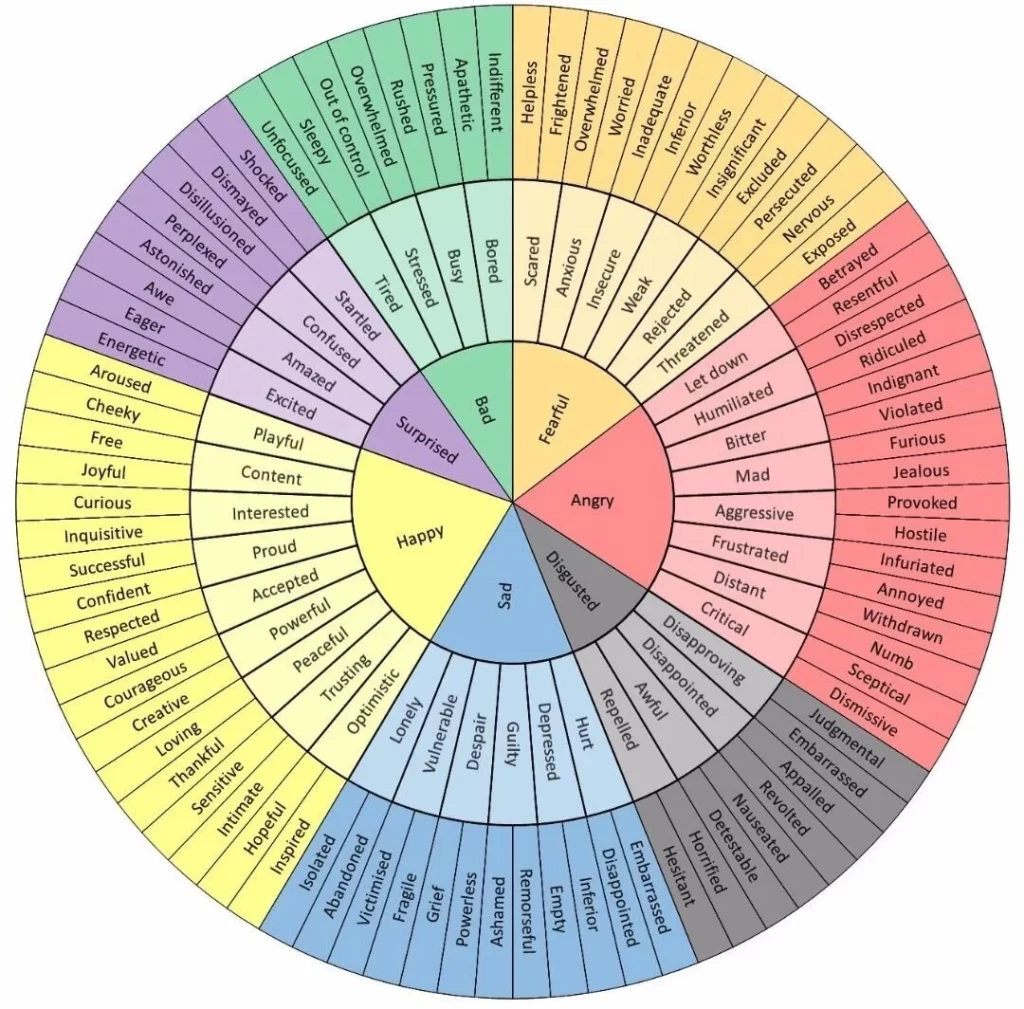
Here’s an image I dastardly took from Google. It’s called the “wheel of emotions” and it’s one of many you can find out there. An excellent resource that I use every day in my practice, because of how much you can get from simply looking at it while introspecting.
Step 3 – Find the Emotion in the Body
The next step is to find where that emotion is in your body.
Every emotion shows up in the body in some way. It’s even in the root of the word, “to stir up”. Every emotion creates mental AND physical changes in the body. It might be a tightness in your chest, shortness of breath, a knot in your stomach, tension in your shoulders, pressure in your head, or even a feeling of emptiness in your stomach or chest.
Instead of thinking about the emotion, your job now is to locate it in your body and hold your attention there.
(Disclaimer: Some people may be so dissociated they can’t perceive these sensations in their own body. This can happen to people that’ve gone through trauma, are living very stressful situations, or have high tendencies towards dissociation in general. In this case, trauma work or similar is recommended to begin reconnecting the body.)
Step 4 – Measure the Intensity
Once you find the emotion in your body, stay with that physical sensation. Don’t try to change it yet, just notice it. Observe it.
Now, I want you to rate the intensity of that sensation on a scale from 1 to 10, where 1 is barely noticeable and 10 is overwhelming.
This number will be your guide. It will help you notice whether the emotion is changing, increasing, or decreasing over time.
Step 5 – The “Chewing” Part
This is where the name of the exercise comes from.
What you are going to do is very simple. As you breathe in, try to feel the emotion becoming slightly more intense, maybe half a point or one point higher on your scale. You are not trying to make it overwhelming, just slightly stronger.
Then, as you breathe out, imagine that some of that intensity leaves your body with the air. Let the sensation go down again to where it was before, or maybe half a point lower.
So you breathe in and the emotion becomes a little stronger. You breathe out and the emotion becomes a little weaker.
You go up a little, then down a little. Up and down, up and down.
Why I Call It “Chewing” Emotions
This is why I call this exercise “chewing” emotions.
Imagine you put a piece of gum in your mouth. At first, the flavor is very strong. Every time you chew, you get more of that flavor. It’s intense and very noticeable.
But the longer you keep chewing, the more the flavor fades. After a while, it feels like you are just chewing on something with no flavor at all. The gum is still there, but it’s not intense anymore. It’s just… neutral.
This is very similar to what we are doing with the emotion. We are not trying to make the emotion disappear immediately. We are “chewing” it, that is, we are allowing it to become a little stronger and then a little weaker, again and again. This teaches the mind and body that a) you can actually tolerate this particular feeling,a nd thus no longer need toa void it; and b) how to keep it at an ideal intensity so that processing can happen.
And as we do this, the emotion slowly starts to lose intensity. It doesn’t necessarily disappear completely, but it becomes manageable. It stops taking over your mind, and you can continue doing what you need to do (working, studying, talking to people, or simply relaxing) without the emotion controlling all of your attention.
Final Step – When to Stop
After a few minutes, you can stop the exercise. You don’t need to do this for a long time, even a few minutes can make a difference.
After you finish, you can take a short walk, drink some water, or simply return to what you were doing. If the emotion is still there, you can come back and repeat the exercise later in the day.
This exercise can feel mentally tiring at first, especially if you are not used to paying attention to your emotions in this way. That is normal. You are using a skill that most people have never trained before.
My clients usually notice that after doing this for a few minutes, the emotion is lower in intensity than when they started. And if you do this regularly, it also helps prevent emotions from accumulating over time until they come out all at once in ways you don’t want or can’t control.
Closing Thoughts
Most people are never taught how to process emotions. They are taught how to avoid them, suppress them, distract themselves, or overthink them. But emotions that are not processed don’t disappear, instead, they stay in the body and in the mind.
Learning how to sit with an emotion, approach it, and allow it to change is one of the most useful psychological skills a person can develop. It does not mean emotions will never be painful or uncomfortable, but it means they will no longer feel uncontrollable or endless.
Emotional regulation is not about controlling emotions. It is about learning how to experience them without being overwhelmed by them and without running away from them.
The goal is not to feel less, but to be able to feel without getting stuck. If you are able to learn this skill, you’ll have won half the battle against most mental disorders out there. And if you want/need extra assistance, don’t hesitate to do so here.