
If you’re a man dealing with OCD, you’ve probably already tried to “just stop” the thoughts.
Here’s why that doesn’t work, and what actually helps to stop OCD thoughts naturally and without medication.
First, let’s be honest about OCD in men
The majority of society still doesn’t really know much about OCD in general. They think it’s just hand-washing or very neat desk organization. Though it can be that (in some cases), the array of potential obsessions that can affect a person with OCD are very vast, and in many cases coexist at the same time.
The types of obsessions (Raismussen & Eisen, 1998) are as follows, with the percentage of how frequently people with OCD had them:
- Contamination (50%)
- Intense “not knowing” about something (usually something troubling) (42%)
- Sexual Obsessions (24%)
- Aggression/Harm Obsessions (33%)
- Somatic Obsessions (33%)
- Need for symmetry (32%)
- Religious Obsessions (10%)
‘But Augusto, you dumbass, they add up to more than 100%!’
Yes, and that’s exactly the point. It’s unlikely to find someone with only one type of obsession. Most commonly you’d find 2–4 in the same person. And this doesn’t even count types discovered after the study’s publication, like relationship-related obsessions (which is so common it’ll have its own post later on.)
What Happens in Men with OCD Specifically
As men, we’re wired to deal with problems head-on: partly due to upbringing, partly due to how masculinity gets framed around control and willpower. So the natural response to intrusive thoughts is to fight them. To argue with them. To avoid whatever triggers them. That strategy feels logical. We tell ourselves it’s a matter of willpower, of standing triumphantly against whatever thought shows up to threaten us.
But that’s exactly how OCD wins: the more we fight, the worse it gets.
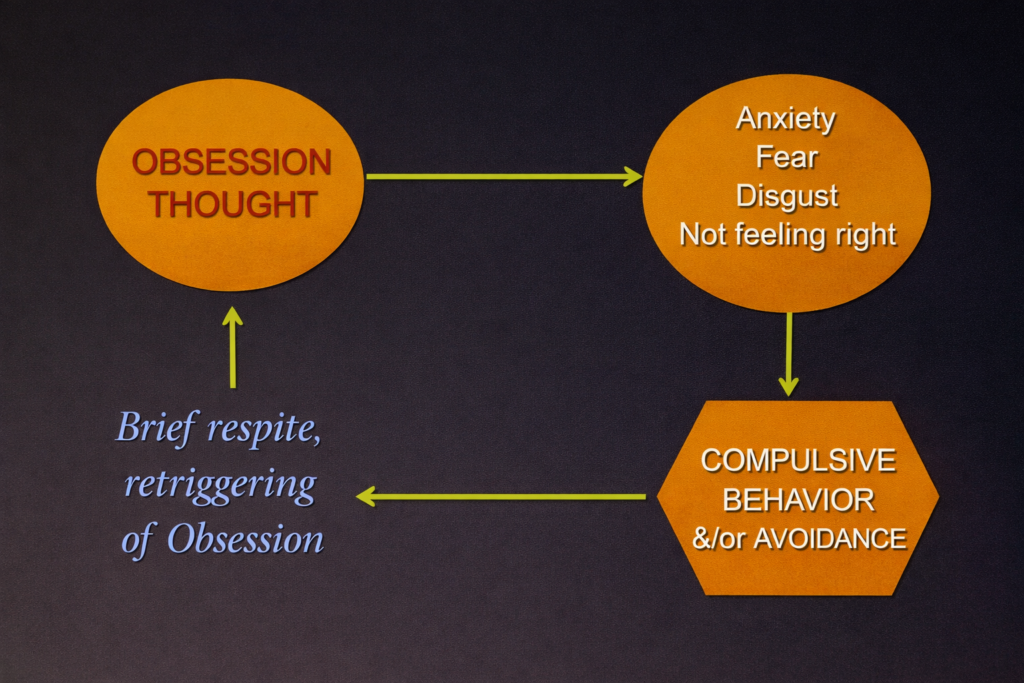
(Image taken from Sarosh’s excellent OCD talk at UCLA.)
OCD feeds on your attempts to neutralize it. Every compulsion (mental or physical) tells your brain the threat was real. It also tells that whatever you did to stop it, from checking something 30 times to counting to 100 in your mind to asking someone else for reassurance 15 times in a day, works to give you relief. And if it works, then it will keep using it more. The moment it can’t, you’re gonna feel trapped and helpless, overwhelmed and out of control.
What “Natural” actually means here
When people search for how to stop OCD thoughts naturally, they usually mean: without becoming dependent on medication, without feeling like they’re broken, and without spending years in therapy that doesn’t go anywhere.
That’s fair. And the tools below are grounded in exactly that. Evidence-based techniques you can start using now. Now, I have to say that seeking professional help (whenever possible) is highly recommended. It can be very hard to break patterns you’ve had, maybe for decades, all on your own.
5 Tools that Actually Work to Stop Intrusive Thoughts
- Exposure and Response Prevention (ERP) – the Gold Standard
ERP means deliberately exposing yourself to the thought or trigger and then not doing the compulsion. Not fighting the thought. Not reassuring yourself. Just sitting with discomfort until it passes on its own. It’s hard. It works. Research consistently shows it’s the most effective treatment for OCD. Every professional worth their salt around OCD will use this to treat you (among other tools if needed). - Label the Thought, Don’t Own it
Instead of “I am thinking about harming someone” try “There goes my OCD again.” This isn’t denial. It’s accurate. And many times your OCD will try to trick you into thinking “no no this is real, it’s not an intrusion. You are like this”. OCD thoughts are not reflections of your character or desires. Let me say that again: OCD thoughts are NOT reflections of who you are as a person or what you want. They are brain glitches. Naming them as such creates distance and reduces their power. Just listen to Simon. - Stop Seeking Reassurance
Googling symptoms. Asking your partner if you’re a bad person. Checking the news to see if anything happened. All of this is a reassurance-seeking compulsion. It provides about 30 seconds of relief and then makes the obsession louder. Cut it off. Every time. Try to reduce it a bit every day or every week, so that the loop shown in the image in this post doesn’t keep happening. - Physical Regulation before Mental Work
When you’re in a spike OCD firing at full volume your nervous system is in threat mode. Slow, deliberate breathing (4 counts in, 6 counts out) or cold water on your face activates your parasympathetic nervous system (this is a DBT TIPP technique, useful for addictions and bipolar as well). It doesn’t fix OCD, but it gets you out of fight-or-flight enough to use your other tools available. - Commit to Uncertainty
OCD’s core demand is certainty. It wants you to be 100% sure you’re not a bad person, not sick, not in danger. You can’t give it that. Nobody can, because it doesn’t exist. The real skill is learning to act meaningfully while uncertain – and accepting that some questions don’t need to be answered right now. This is why Acceptance and Commitment Therapy (ACT) has also been successful in managing OCD symptoms.
What men get wrong about OCD recovery
| MYTH If I understand where my OCD comes from, it will go away. | REALITY Insight doesn’t reduce OCD. Behavioral change does. Knowing why doesn’t stop the loop and can even feed it. |
| MYTH The goal is to never have intrusive thoughts. | REALITY Everyone has intrusive thoughts. They’ll never stop. The goal is to stop caring about them so much so you continue doing your usual activities with ease. |
| MYTH Willpower and discipline should be enough to beat this. | REALITY OCD is a neurological pattern. Willpower alone doesn’t rewire it, instead structured practice does. |
| MYTH Therapy is for people who can’t handle things themselves. | REALITY ERP is a skill and therapy is like the gym. Learning it with a trained therapist is the fastest, most effective path. |
When to get professional help
If OCD is interfering with your work, relationships, or daily functioning (even a little) that’s the threshold. You don’t have to be in crisis. You don’t have to have it “bad enough.” If it’s costing you time and energy, it’s worth addressing with someone who knows how to treat it.
Look specifically for a therapist trained in ERP and OCD. Not all therapists are. Asking about their specific OCD training is not rude, it’s smart. If you want to start somewhere, look no further.