
Why anxiety can cause Erectile Dysfunction (ED) and what to do about it
Look, most articles on this topic are going to tell you the same thing: anxiety affects your body, stress is bad for your sex life, try to relax. And then they’ll list a few symptoms you already know and send you on your way with zero concrete answers.
That’s not what this is.
I’m going to tell you exactly what happens in your body when anxiety kills an erection, why it locks in as a pattern, how to tell whether what you’re dealing with is psychological or physical, and what actually works to fix it. Not in the abstract. In concrete terms.
If you’ve been looking for a straight answer on this, you’ve found it.
Quick answer
Yes, anxiety can cause erectile dysfunction, and it does so through a direct physiological mechanism, not just “being too stressed.” Our autonomous nervous system (the one that’s not voluntary) is divided into two subsystems: the sympathetic and the parasympathetic.
The first one prepares the body for fight or flight. It increases blood pressure, oxygen intake, shoots adrenaline to our veins, makes us alert and hyperaware, and makes us put our guard up. It tells us that we are in danger.
The second one prepares our body for rest and digestion. It relaxes our whole body and gives us a chance to rest and recover, brings down our activation levels and more importantly, it allows us to enact behaviors that require us to be in a safe, non-perturbed state for a long time, namely sleeping, studying and having sex.
This is very logical. Imagine what happens to an animal that’s in a dangerous area and starts sleeping or having sex there. They’d be super easy prey. That’s why our evolution requires us to be in a place where we know there’s no threats around: we’d be easy prey otherwise.
When anxiety is present, the sympathetic system stays activated and you shift into a state that makes erections functionally impossible. Your body keeps getting signals that it’s not safe. The good news is that psychological ED is highly treatable. The bad news is that most men either ignore it, try to push through it, or take medication that addresses the symptom without touching the cause.
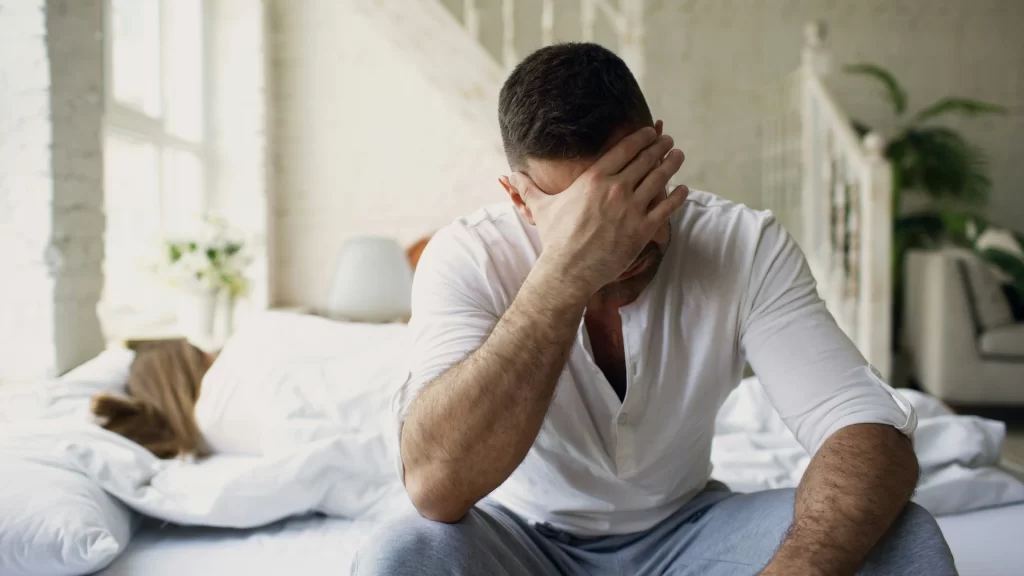
The feedback loop
This is where it gets particularly difficult to break on your own.
The first time it happens, it’s usually situational only. Too much to drink, a stressful week, bad sleep, first time with someone new. All those circumstances get together and boom, erections don’t work that day. It happens, it passes, some men move on.
But others don’t. Instead, the next time they’re in a sexual situation, some part of them remembers what happened last time, and thus creates an association. That memory generates anxiety. That anxiety activates the sympathetic system. And now the thing they were afraid of happening is significantly more likely to happen not because anything is physically wrong, but because the anxiety itself is causing the problem it’s afraid of.
One failed erection becomes performance anxiety. Performance anxiety causes the next failed erection. That failure intensifies the anxiety. The anxiety causes the next failure. The cycle locks in.
Over time the anticipatory anxiety starts showing up earlier and earlier: way before the sexual situation even begins. Some men even start avoiding intimacy altogether to avoid the possibility of failure, if you can believe that. Others go through the motions while completely in their heads, disconnected from their body and their partner, running a constant background assessment of how things are going. They are not having a good time, they are taking a test, one they’d feel horrible about failing.
Neither of these helps. Both make it worse.
This is the mechanism. Understanding it is important because it tells you where the intervention needs to happen. We gotta break you free from that feedback loop.
Types of anxiety that cause ED
Not all anxiety that causes ED looks the same. We can subdivide anxiety depending on its causes. Knowing which type you’re dealing with tells you where to strike.
Performance anxiety
This is the most common one and the most directly tied to the feedback loop described above. Performance anxiety is specifically the fear of failing sexually, that is, not being able to get hard, not staying hard, not satisfying your partner.
The focus shifts from being present in the experience to monitoring and evaluating how things are going. That monitoring is itself the problem because you cannot be simultaneously inside an experience and evaluating it from the outside. The moment you shift into critic mode, you’ve left the parasympathetic state that makes the whole thing work.
Performance anxiety tends to be situational at first like with a new partner, after a period of no sex, after the first time it happened. Left unaddressed, it generalizes and creates the above loop.
Generalized anxiety
Some men aren’t anxious specifically about sex. They’re anxious about everything (work, finances, relationships, the future) and so now the anxiety is simply always there, running in the background at a level that keeps the sympathetic system chronically activated.
For these men, ED isn’t a sexual problem. It’s a symptom of a much bigger issue. A nervous system that never fully comes down to baseline. The bedroom is just one other place where it shows up.
Relationship anxiety
Unresolved tension, resentment, disconnection, or conflict in a relationship creates a specific kind of emotional static that interferes directly with sexual function.
A man who doesn’t feel safe with his partner emotionally (whether because of trust issues, ongoing conflict, or a growing sense of distance) will struggle to feel safe enough physically to be fully present sexually. I can tell you for a fact, a lot of men I’ve worked with developed ED after finding out they were being cheated on. Take that as you will.
Emotional safety and physical arousal are not as separate as most men assume.
Body image and self-consciousness
Dysmorphia and bigorexia are no joke. If you struggle with your body image then having sex, which involves losing clothes and showing parts of your body to another person, is a huge deal.
Feeling self-conscious about your body, your size, your performance history, or how you’re being perceived mid-sex creates the same observer effect as performance anxiety. Part of your attention is on the experience. Part of it is on how you look, how you’re doing, what your partner is thinking. That split attention pulls you out of the parasympathetic state and into your head. The result is the same.
How to tell if yours is psychological or physical
Again, this is huge because the interventions are vastly different. We are talking up to 50% of ED being psychological. Treating psychological ED with medication alone is like taking painkillers for a broken bone. You are not fixing the root cause of your problem.
A few reliable indicators:
- You can get erections alone but not with a partner. This is the clearest signal. If the mechanism works in low-anxiety situations (solo, half-asleep, in the morning) the plumbing is fine. The problem is contextual, which means it’s psychological.
- Morning erections are present. Nocturnal and morning erections are involuntary and happen independently of psychological state. If they’re occurring regularly, your body is capable of full erectile function. The issue is what happens when the mind gets involved.
- It’s situational. Works with some partners but not others. Works when things are going well in the relationship but not when there’s tension. Works on holiday but not at home. Situational ED is almost always psychological.
- It started after a specific event. A humiliating sexual experience, a relationship breakdown, a period of high stress, the first time it happened and the anxiety that followed. If you can trace the onset to something specific, that’s a strong indicator of psychological origin.
- It came on suddenly rather than gradually. Physical ED tends to develop gradually over time as vascular or hormonal function declines. Psychological ED tends to appear suddenly, often in specific contexts.
If you’re under 40 and your ED is situational, the odds are strongly in favor of a psychological cause. That said, if you haven’t ruled out physical causes (cardiovascular issues, low testosterone, diabetes, medication side effects) a visit to your doctor first is the right move. Not because it’s likely physical, but because you want to know.
What to do about it
The goal is straightforward even if the work isn’t: get your nervous system back into a state where it’s no longer feeling under threat and arousal is possible, and break the feedback loop that’s been keeping it out.
Address the anxiety directly, not just the symptom. Medication like Viagra or Cialis works by enhancing blood flow, and it can be useful as a short-term tool to interrupt the failure cycle and rebuild some confidence. But it doesn’t touch the anxiety driving the problem. Men who rely on it indefinitely without addressing the underlying anxiety tend to find that the psychological dependence on the medication becomes its own problem. Use it as a bridge, but never as a destination.
Get out of your head and into your body. The critic mode (monitoring your performance mid-sex) is one of the most direct causes of psychological ED. The intervention is learning to redirect attention from evaluation back to sensation. What you’re feeling physically, what’s happening in your body, your partner’s responses.
This sounds simple. For men who’ve been in their heads during sex for years, it requires deliberate practice. Mindfulness-based approaches work well here specifically because they train exactly this: sustained attention on present-moment sensation without judgment. Learn them. Use them.
Work on the feedback loop directly. This often means temporarily removing the pressure of performance from sexual situations altogether. Sensate focus, developed by Masters and Johnson, is a structured approach that does exactly this: it reintroduces physical intimacy in a graduated way without performance expectations, giving the nervous system repeated experiences of arousal without the threat of failure. It’s one of the most evidence-based interventions for psychological ED and almost no popular article on this topic mentions it.
If it’s relationship anxiety, the relationship needs attention. Sexual function doesn’t improve in a vacuum. Being also a couples therapist I can tell you that if the ED is rooted in disconnection, unresolved conflict, or trust issues with your partner, those need to be addressed directly period. Doesn’t matter if it’s through honest conversation, couples therapy, or both, this needs to happen.
The bedroom reflects everything else. Fix the everything else.
Regulate your baseline. If generalized anxiety is the driver, the work is upstream of sex entirely. Sleep, exercise, reducing chronic stressors, and in many cases therapy to address the anxiety at its root. A nervous system that’s chronically activated doesn’t suddenly switch off in the bedroom. Bring the baseline down and the sexual function tends to follow. A technique called Progressive Muscle Relaxation is perfect for this.
Get professional support. Psychological ED is one of the most treatable presentations I work with. The feedback loop, once you understand it and have the right tools, can be broken. But trying to work through it alone (through willpower, through pushing through, through avoidance) can entrench it further. It takes a lot of learning and reflection to be able to do this on your own. Alternatively, you can get a professional that already has years of work behind him to give you the relevant bits and get you results.
If this has been going on for more than a few months, that’s long enough to have tried on your own.
Common Myths
“If it happens, something is permanently wrong with me.” It’s not permanent and it’s not a verdict on your masculinity. Psychological ED is a nervous system response to a perceived threat. It’s not structural damage, it’s not irreversible or anything like that. Let me say this again: it has nothing to do with how attracted you are to your partner or how capable you are as a man. It’s a pattern. Patterns can be changed.
“I just need to relax.” Correct diagnosis, useless prescription. Telling a man with performance anxiety to relax is like telling someone with trying to date to ‘just be confident’. The anxiety isn’t a choice he’s making. “Just relax” gives him one more thing to fail at in the moment, which adds to the anxiety, which makes the problem worse. Relaxation is the outcome of the right interventions, those are the things you need, concrete interventions.
“Viagra will fix it.” Viagra addresses blood flow. It does not address the anxiety driving the problem. Some men find it useful as a short-term confidence tool, which is legitimate. But men who use it indefinitely without doing the psychological work often find that they develop anxiety about what happens if they don’t have it, which is just the original problem wearing a different coat. Medication is a tool, not a solution.
“This only happens to older men.” Psychological ED specifically skews younger. The vascular and hormonal factors that contribute to physical ED tend to develop with age. Performance anxiety, generalized anxiety, and the feedback loop described in this article can happen at any age and are particularly common in men in their 20s and 30s, who are often the last to seek help because they assume ED is something that happens to older men.
“If I was really attracted to her, this wouldn’t happen.” Attraction has nothing to do with it. A man can be intensely attracted to his partner and still experience anxiety-driven ED because the problem is in his nervous system, not in his desire. In fact, the more attracted he is and the more the encounter matters to him, the higher the stakes, and the more likely anxiety is to show up. This myth is particularly damaging because it adds a layer of shame and confusion on top of an already difficult experience.
Final thoughts
Anxiety-driven ED is one of the most common things I see in my work with men, and it’s incredible how much damage and suffering it can create.
The pattern is clear: something happens, the anxiety about it happening again takes root, the feedback loop locks in, and the man either pushes through it alone for months or years, or avoids intimacy altogether, or medicates the symptom without touching the cause. None of those approaches fix anything long-term.
What does fix it is understanding the mechanism clearly enough to intervene at the right level, which is what this article was designed to give you. The nervous system that learned to associate sex with threat can learn to associate it with safety again. We just need to do the right adjustments.
If this has been going on for a while and you want to address it properly, that’s exactly the kind of work I do.
Can anxiety cause ED even if I’m young and healthy?
Yes, and it’s actually more common in younger men than most people realize. Physical ED tends to develop gradually with age as cardiovascular and hormonal function changes. Anxiety-driven ED can happen at any age and frequently shows up in men in their 20s and 30s, often precisely because the stakes feel higher and the expectation to perform is greater.
.
How do I know if my ED is from anxiety or something physical?
It’s simple. If erections are present in low-pressure situations (alone, in the morning), that means that your body works fine. It just gets blocked in certain situations. Once you figure out which situations you can’t get erect in, you’ll be able to find the common denominator.
.
Can performance anxiety cause permanent ED?
No. Anxiety-driven ED is not structural damage. There’s no nerve damage, or blood flow issue, or anything of the sort. The underlying mechanism (parasympathetic activation) is intact. What’s happening is a learned association between sexual situations and threat that keeps the sympathetic system activated at the wrong moment. Learned associations can be unlearned with the right approach. Permanent ED from anxiety alone is not a realistic outcome.
.
Does Viagra help with anxiety-induced ED?
It can help in the short term by interrupting the failure cycle and rebuilding some confidence. But it doesn’t address the anxiety causing the problem. Men who rely on it without doing the psychological work often develop a dependence on it that creates its own anxiety. This means that the moment they find themselves without Viagra, anxiety will hit ten-fold. Viagra is best used as a temporary bridge alongside actual treatment, not as a long-term solution.
.
Will this go away on its own?
Sometimes, if the trigger was situational and the anxiety doesn’t take root. More often it doesn’t because without intervention, the feedback loop tends to self-reinforce over time. The longer it goes unaddressed, the more entrenched the pattern becomes. Waiting it out is a strategy that works for some men and makes it significantly worse for others. If it’s been going on for more than a few months, that’s long enough.
.
Is this something therapy can actually fix?
Yes, obviously. Psychological ED is one of the most treatment-responsive presentations in men’s mental and sexual health. No joke, it’s super easy to treat. The issue is a lot of men feel so ashamed about it that they don’t look for help. Once they actually take the step, it can take as little as a month to finally be okay.
.