
This is a guide that explains what happens and then how to get over a breakup, in clear detail.
I’m going to divide this article into two parts.
The first part will focus on what specifically happens in your body after a breakup, and why you can feel like absolute shit during this period.
The second part will be the practical one. I’ll walk you through, step by step, what you can actually do to start moving forward. What habits, activities, and behaviors can help you work through the breakup, find closure, and come out of the experience with a stronger sense of identity and greater confidence in yourself.
When it comes to breakups (which are one of the most common problems people bring into a therapist’s office) you’ll usually find one of two types of articles, guides, or pieces of advice.
The first one simply lists tip after tip. The advice may sound good, and it may even be effective, but it’s often not concrete enough. It doesn’t explain how or why these things are supposed to work; it simply asks you to trust that they will.
You’ll see things like: “Go exercise.” “Take some time for yourself.” “Process your emotions.”
But if you’re someone who doesn’t already know how to do these things, you’re naturally going to have a whole bunch of questions.
Okay, how do I do that? For how long? Is any type of exercise good enough? Are there certain types of exercise or sports that work better than others? What does it actually mean to “process my emotions”? How do I know if I’m actually processing them, rather than just making myself feel worse? And what does “take some time for yourself” even mean in practice?
These are all completely natural questions – and they’re questions that these types of pages often don’t actually answer.
Yes, I’ll answer them further into the article.
The other type of information I see is the kind that is highly technical and relies heavily on biological explanations.
These articles will talk about what happens in your mammalian brain. They’ll explain how different parts of your brain interact with each other, what happens when your brain detects a threat, how different neural circuits become more or less active depending on the response, yada yada.
And there’s nothing wrong with that per se. For some people, it can actually be fascinating and helpful to understand the neuroscience behind what they’re experiencing. Learning about how social rejection and relationship loss can engage systems involved in stress, threat, reward, attachment, and even the experience of pain can make what you’re going through feel a little less mysterious.
But there’s a problem: for the average person going through a breakup, this information can be difficult to understand – and they may simply not have the energy to care.
You’re going through a breakup. You feel like shit. You’re probably thinking about your ex constantly, struggling to sleep, eating differently, or trying to figure out how you’re supposed to get through the next few days. You probably don’t feel like sitting down to learn about the amygdala, neural circuits, and the evolutionary history of the mammalian nervous system.
And yes, maybe understanding some of this biology can be useful. But knowing that your brain is responding to social loss through a complex interaction between systems involved in threat, attachment, reward, stress, and emotional regulation doesn’t necessarily tell you what to do with that information.
That’s the part I think is often missing.
You don’t just need to know why you feel this way in an accessible way. You need to know what to actually do about it.
So let’s get down to it.

Quick answer
A breakup is, at its core, an attachment loss.
It may also come with a perceived hit to your ego or identity, as well as the loss of access to some of the spaces, people, and tools you used to regulate yourself.
That means that, after a breakup, you may need to learn how to regulate yourself on your own, heal that potential wound to your ego or sense of identity, and process the loss of the attachment itself.
Ultimately, the goal is to recover the psychological energy and attention that were invested in the other person and gradually redirect them back toward yourself and your own life.
The mechanism
As I mentioned above, three things can happen when a breakup shows up in your life: an attachment loss, a perceived hit to your ego or identity, and a loss of regulatory tools that were previously available to you.
We’re going to go through them one by one.
1. Attachment Loss
We are social beings. This has been extensively studied across virtually every field of science that deals with human behavior. We tend to do better when we collaborate with others, live in groups, and form strong social bonds – kind of like ants, although obviously a little more complicated.
Because of this, humans have evolved a whole set of biological and psychological systems that allow us to form and maintain strong bonds with other people, including romantic bonds.
So when one of those bonds is suddenly broken, it makes sense that your brain and body don’t simply go, “Oh well, moving on.”
Instead, a number of systems involved in attachment, stress, reward, motivation, and social connection become activated. Depending on how deep and significant the relationship was, these responses can be quite intense. You can find yourself thinking about the person constantly, wanting to contact them, replaying memories, looking for signs that the relationship could be restored, or simply feeling an almost physical sense that something is missing.
From an evolutionary perspective, this makes sense. For a social species like ours, maintaining important relationships and staying connected to the group has historically been highly valuable for survival and wellbeing. The systems that motivate us to seek connection and respond to its loss didn’t appear out of nowhere.
And this is where grief comes in.
Grief is, in part, the emotional response to realizing that something important in your life is no longer there. It reflects the significance of the bond you lost while also forcing you to gradually adapt to the reality that the relationship, in its previous form, is no longer available.
In other words, the intensity of your reaction isn’t necessarily evidence that something is wrong with you. It is evidence that the relationship was deeply important.
Your brain and body are responding to the loss of something they had learned to treat as important.
That won’t stop in a day or two, but we have ways of making sure you will get better.
2. The Hit to the Ego
The second thing that can happen is a hit to your ego, or what we might call a wounded ego or a wounded sense of identity.
Basically, your mind has just experienced the breakup as an attachment loss, but it may also interpret it as something that says something about you.
Depending on how you were raised, what experiences you’ve had throughout your life, what happened during the relationship, and especially how the relationship ended, the breakup can be interpreted as evidence that you are worse than you thought you were.
Maybe you were cheated on, for example. Now some part of your mind starts comparing you to the other person and saying:
See? You’re not man enough. You’re not good enough.
Or maybe the breakup touches on insecurities you’ve been carrying for years and reinforces them:
See? You’re not good enough to be loved.
You’re not attractive enough.
You lack the qualities people need to appreciate and respect you.
You just suck.
And it doesn’t have to reinforce only negative beliefs about yourself. Even positive ideas you have about yourself can suddenly be put into question.
Maybe you see yourself as attractive, respectful, reliable, responsible, or someone who is a good partner. But then the relationship ends, and you find yourself thinking:
If I’m all of those things, why wasn’t that enough to keep this relationship going?
Was I wrong about myself?
Does this mean I’m not actually the person I thought I was?
Have I been lying to myself this whole time?
What am I missing?
This is where we’re talking about a wounded ego, or more precisely, a wounded sense of identity.
The breakup isn’t necessarily telling you that any of these negative conclusions are true. But it can create enough uncertainty around your sense of self that your mind starts looking for an explanation – and sometimes, the explanation it finds is, “Maybe there was something fundamentally wrong with me.”
And that’s important, because now you’re dealing with more than the loss of another person.
You’re also dealing with a threat to the story you had about yourself. Without proper tools to handle this, it can be devastating.
3. The Loss of Regulatory Tools
Finally, we have the loss of access to the tools and sources of support that you previously used to regulate yourself.
I’ve seen that a lot of people have a particularly hard time coping with breakups when a large part of their life (or sometimes most of it) involved their partner.
These might be people who don’t have many friends, so they used to spend most of their social time with their partner. They may not have much contact with their family, or their family may live far away. Their partner may have been the one person they could consistently rely on.
They may also not have many routines, hobbies, or leisure activities that belong exclusively to them. Most of what they did was either shared with their partner or consisted of work and other responsibilities – which, while important, aren’t necessarily the things they turn to when they want to relax, have fun, or feel like themselves.
And then there is emotional regulation.
Maybe something went wrong at work, and their partner was the person they called. Maybe they had an argument with a family member, and their partner was the person they talked to afterward. Maybe they were distressed about something happening in the world, and their partner was the person who helped them calm down and put things into perspective.
Over time, the partner can become an important part of how a person regulates difficult emotions.
And then the breakup happens.
Suddenly, that person is no longer available in the same way. The routines are gone. The shared activities are gone. The daily conversations are gone. And the person who may have been your biggest source of emotional support is suddenly no longer there.
It’s like losing a pillar that was holding up a significant part of your life.
And when that pillar disappears, you don’t just miss the person. You feel the lack of the structure that was built around them.
This is why rebuilding your life after a breakup isn’t simply about distracting yourself until you stop thinking about your ex. You need to build a foundation that can support you without depending on one person to hold everything together.
That means developing your friendships. Reconnecting with family when possible. Building routines that belong to you. Finding activities you actually enjoy doing on your own. Learning how to regulate difficult emotions on your own. Creating sources of meaning, connection, and enjoyment that don’t depend on having a romantic partner.
Because if the rest of your life is still unstable, you’re going to feel an enormous pressure to get that pillar back.
And that can lead to desperate attempts to restore the relationship, even when going back isn’t actually what is best for you.
The goal isn’t to become someone who doesn’t need anyone.
The goal is to become someone whose entire foundation isn’t resting on one person.
How Breakup Distress Can Show Up in Men
So, what does all of this actually look like in real life?
There isn’t one universal way men respond to a breakup. But there are a few patterns I see particularly often.
Total avoidance
Some men go straight into “I’m fine.”
They bury themselves in work, the gym, video games, going out, or anything else that keeps them from having to sit with what they’re feeling.
From the outside, this can look like they’re handling the breakup really well. They’re functioning. They’re busy. They’re not crying. They’re not talking about their ex.
But I can assure you, that’s not processing. It’s complete avoidance. Every time someone does this, they eventually crash and burn. Hard. Don’t let yourself fall into that too.
Overthinking, rumination and trying to figure out what went wrong
Another common response is to turn the breakup into a problem that needs to be solved.
You replay every conversation. You analyze every text message. You think about what you could have said differently. You compare yourself to other men. You try to identify the exact moment when everything went wrong.
This can feel productive because you’re doing something.
But most of the time, you’re not actually solving anything. You’re trying to regain a sense of control over something that has already happened.
There is a point where reflection becomes rumination: you’re asking the same questions over and over, without arriving anywhere new. You can change this to something that actually works.
The rebound
And then there is this classic: the rebound.
You find someone new as quickly as possible, not because you’re ready to build a new relationship or because you’ve found the love of your life, but because being with someone else temporarily takes away the feeling of loss.
And short term, this can work! You find someone, you have sex again, life is great for a while.
…then one or two weeks go by and that grief that was being held at bay comes crashing down all at once, and it shows you how deluded you were into thinking you could escape this. Add to that, now you have another person to deal with, cause they are still interested and want more time and openness from you. This is where ghosting, self-sabotage and avoidance really show up and push the new person away.
Now you have a delayed grieving process, that’s just as it was when you started and you’ve hurt someone else that had nothing to do with it in the first place.
Also, from my experience, ED and other sex disorders are much more likely to show up here.
As I said, good ole’ classic rebound.
Anger instead of sadness
Now, this has to be said because I’ve faced many clients who got violent with their ex.
Sadness can be difficult for some men to express, while anger may feel much more familiar or acceptable.
So instead of “I’m heartbroken,” the emotion becomes:
“She treated me like shit.”
“I can’t believe she did this to me.”
“I’m never trusting women again.”
Anger isn’t necessarily a bad or illegitimate response. But when it becomes the only emotion you’re able to access, or it shows up through violence, it must be addressed as it’s making things worse for you and prevents you from actually moving on.
How to tell if you’re processing well or stuck
One of the hardest things about a breakup is knowing whether you’re actually getting better or simply getting better at avoiding the pain.
Here are a few questions you can ask yourself that will give you much clearer answers:
- Can I think or talk about the relationship without immediately becoming overwhelmed by anger, shame, or sadness?
Over time, you should be able to remember the relationship without being completely pulled back into it. If time goes on and you keep being overwhelmed, processing may not be happening.
- Can I remember the good parts without idealizing the relationship?
It’s normal to miss someone. But if your mind has turned your ex into the perfect person and the relationship into the perfect relationship, you’re probably remembering selectively.
Grab a piece of paper and write down 10 things you didn’t like about your partner. If you can’t, you are idealizing.
- Am I still checking her Instagram, stories, or other social media?
If you’re repeatedly looking for updates, signs, clues, or evidence that she’s thinking about you, you’re still feeding the attachment loop.
- Can I be alone without immediately trying to fill the void?
You should become more capable of spending time by yourself without desperately needing another person, distraction, or relationship to make the pain go away.
- Am I rebuilding parts of my life that existed outside the relationship?
Are you seeing friends or making new ones? Reconnecting with family? Developing hobbies? Taking care of your body? Building routines that belong to you?
- Am I learning something about myself, or am I just trying to find out what I did wrong?
Healthy reflection can help you understand your patterns and make better decisions in future relationships. Rumination keeps you trapped in the past, looking for an answer that may not exist.
- Is my life gradually getting bigger again?
This may be the simplest question of all.
You don’t need to feel great yet. You don’t even need to feel like you’re completely over the relationship.
But if, week by week, your world is slowly becoming bigger than your breakup again (if you’re thinking about other things, enjoying other activities, connecting with other people, and investing energy into your own life) that’s a good sign.
You’re not just forgetting the relationship.
You’re rebuilding yourself around the loss.
What to Actually Do About It – Practical Tips
So, now that we understand what is happening, what can you actually do about it?
1. Stop avoiding the emotion and learn how to process it
One of the most common pieces of advice you’ll hear after a breakup is “allow yourself to feel your emotions.”
But what does that actually mean?
I’ll tell you.
I divide this process in three stages: recognition, activation, and articulation.
Recognition means identifying what you’re actually feeling. There are some 3000 words for emotions (here are just a few). Knowing precisely and accurately what is going on in your body, gives your mind direction when it comes to digesting stuff.
Think about it this way: if you go to the doctor and you just say “I feel bad”, how many questions would it take for the doctor to figure out what’s going on? How much more time and effort can you save them by saying “I have acute pain in my stomach every time I wake up in the morning, which then goes away after a few hours”.
Your mind is the doctor. The more precise you are with what you feel, the easier it is to treat the stuff.
Here is how to start. Use the image below to figure out what you feel. It’s called an Emotions Wheel and it’s fantastic (I have clients who print it out and have them in their wallets all the time).
Sit down, go word by word spending 5 seconds on each and pay attention whether something resonates in your body or not. You’ll end up with a list of words that start giving you a clearer picture of what’s going on inside of you.
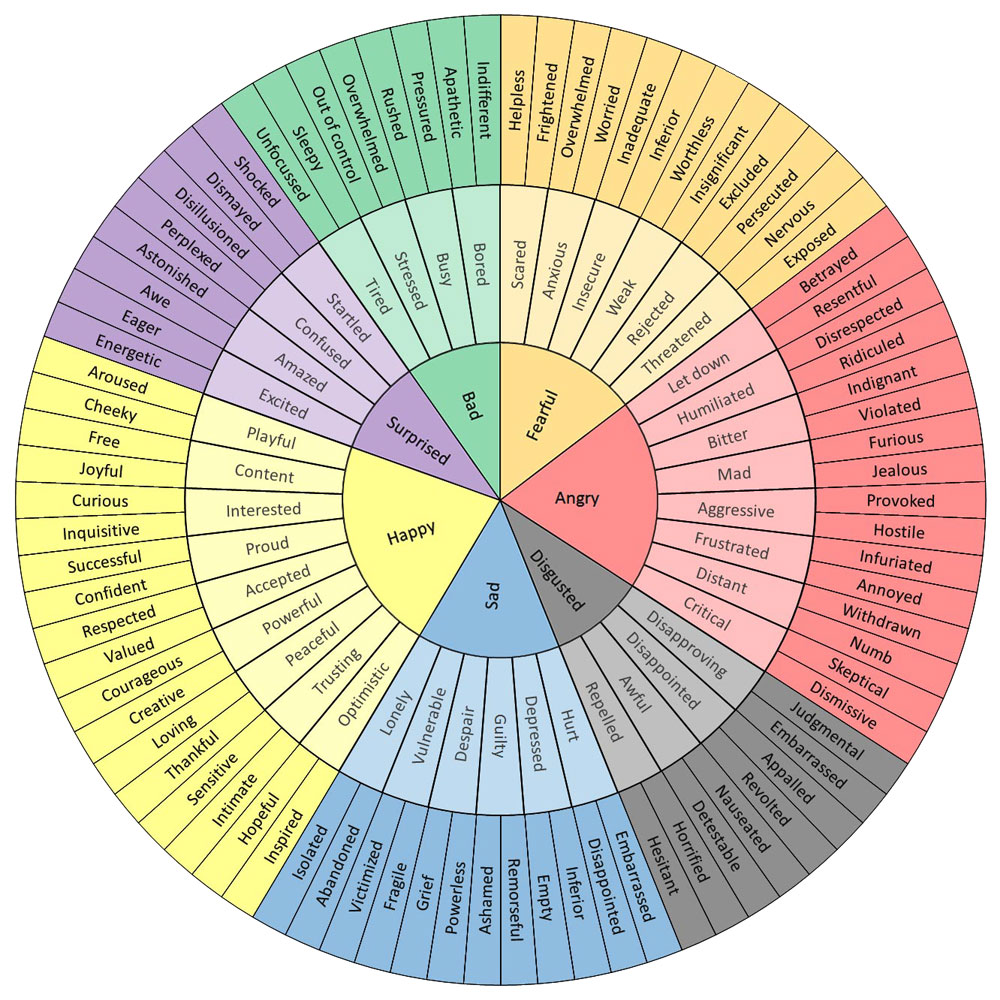
Activation means allowing yourself to actually experience an emotion without letting it overwhelm you or immediately suppressing it.
Once you start paying attention to what you’re feeling and become more precise about naming what’s happening inside you, you’re likely to run into one of two problems – and sometimes both at different points.
Either the emotion comes on too strongly and overwhelms you, or your mind gets scared by how intense it feels and decides to shut everything down. It essentially turns the lights off.
What we’re looking for is the middle path.
Think of it as walking a tightrope without falling to either side. You don’t want the emotion to be at 100% intensity, where it completely takes over and you’re unable to think, function, or do anything with it. But you don’t want it at 0% either, where you’ve completely disconnected from it and are avoiding the experience altogether.
As a practical rule of thumb, you can think of the sweet spot as somewhere around 40–60% intensity. Enough that you’re connected to the emotion and can actually experience it, but not so much that it overwhelms your ability to stay present and work with it.
Why does this matter?
Because when an emotion is at a manageable level, your mind can start doing something with it. You can pay attention to it, understand it, put it into words, and gradually digest the experience.
If the emotion is too intense, the process can become overwhelming and you may end up shutting down or desperately trying to escape it.
If it’s too weak (or if you’ve completely disconnected from it) there isn’t much to work with in the first place.
Think about it like weightlifting.
If the weights are too heavy, you can’t lift them. You’re not going to get much of a workout because the load is simply beyond your current capacity.
If they’re too light, you may be moving the weight, but you’re not giving your muscles enough of a challenge to stimulate meaningful growth.
You want the weight to be difficult enough to challenge you, but manageable enough that you can actually lift it.
Emotions work in a similar way.
You want to be able to feel the emotion without being crushed by it.
That’s the sweet spot where you can actually start working through what you’re experiencing rather than either drowning in it or avoiding it completely.
Here is an in-depth guide on how to achieve that.
Articulation means putting the energy that comes with the emotion and discharging it adequately. We often see people think negatively of certain emotions because of how other people articulate them inadequately. If every time I get angry I break things, hurt the people I love, or lose my cool and embarrass myself, that means my articulation is terrible.
However, once you properly engage the previous two stages, you’ll discover something interesting: articulating emotions becomes easier. Now you can engage in arguments for a prolonged time without yelling or becoming overwhelmed like before. You can be nervous onstage and still not blank out. You can sit down and have uncomfortable, but necessary, conversations with people, conversations that will help that relationship grow stronger.
The emotion no longer controls you. You’ve learned how to navigate it appropriately.
If emotions are the river’s current, you’ve learned how to steer the ship away from the rocks and toward where you actually want to go. You’re no longer at the mercy of the current; you’re reading it, working with it, using its force instead of being dragged by it.
So look for ways to, while feeling these things, pour them outside in ways that you agree with. Ways that don’t leave a mess behind for you or for the people around you to clean up.
2. Cut real contact
If you’re trying to recover from an attachment loss, repeatedly exposing yourself to the person you’re attached to is usually going to make that process much harder.
I’d only recommend some type of contact to already emotionally-savvy people who can properly separate things. Else, minimum contact is best.
So, what does “no contact” actually mean?
If you’re still texting every day, checking her Instagram, watching her stories, finding excuses to ask how she’s doing, or other ways of pouring more energy into her than what’s strictly necessary for work or other commitments, then it’s too much.
Again, this doesn’t mean that staying friends with an ex is always impossible or unhealthy. But if your goal is to recover from the breakup, you need to be honest about whether this contact is actually friendship or whether it’s attachment maintenance disguised as friendship.
3. Devote time to the breakup every day
Imagine you have a computer you need to use to render an HD video. Anybody who works in editing can tell you how resource intensive a task like that is, to the point where no other activities should be performed at the same time while rendering happens.
And it can take hours. Let’s say this particular video will take 8 hours to fully render.
Now, what’s gonna happen if instead of letting that happen, you play some videogames first, then join Zoom calls for your work, then watch a movie on it with friends, and finally turn it off when night comes because it’s time to sleep?
Exactly, nothing will get done in that regard. The video will still be there waiting to be rendered.
Our brain is that computer. If you don’t allot time to actually ‘render’ the breakup and instead are constantly distracted by work assignments, social gatherings, hobbies to the point of never being able to sit in silence for at the very least 15 minutes to actually process stuff, how are you ever supposed to finally break free from it?
15 minutes in silence everyday. Here’s an exercise to work on those emotions. This is non-negotiable.
4. Rebuild your identity outside the relationship
A breakup can leave you with a surprisingly difficult question:
Who am I now?
Especially if a large part of your identity was built around being someone’s partner, you will probably have to rediscover what belongs to you and you alone.
This means rebuilding your friendships, interests, routines, goals, and sense of competence.
For men in particular, this can sometimes involve looking at parts of identity that were closely tied to being a provider, a successful partner, or someone who was supposed to have his life figured out.
The goal isn’t to become a completely different person.
It’s to make sure that your identity is bigger than your relationship status and no longer tied to the other person.
5. Know when to seek professional help
Look. You don’t have to wait until you’re completely falling apart before talking to a therapist.
Professional help that knows how to deal with this can make the whole process more efficient: less time needed, faster recovery, deeper work and acquiring tools that may be impossible otherwise. You can learn more here.
A therapist can also help you distinguish between normal grief and a pattern that is keeping you stuck.
Sometimes, the breakup is painful because you lost someone you loved.
Sometimes, it’s painful because the breakup activated something that was already there.
And sometimes, it’s both.
Common myths
- “I need to be over it within a certain amount of time.”
There is no universal deadline for getting over a breakup.
How long it takes depends on the relationship, how significant the attachment was, how the breakup happened, your previous experiences, your support system, and what else is happening in your life. Lots of things.
Comparing yourself to someone who “got over their ex in two weeks” doesn’t work unless you have all the above data. Your goal isn’t to meet an arbitrary deadline. Your goal is to gradually rebuild your life and become less controlled by the loss. Follow your gut on this.
- “If it still hurts, I haven’t gotten over it.”
Getting over someone doesn’t necessarily mean that you stop feeling anything.
You can still miss someone, feel sad about what happened, or occasionally wonder how they’re doing while having genuinely moved forward with your life.
The better question isn’t “Do I still feel anything?”
It’s “Does this feeling still control me?”
If the pain is gradually becoming less intense, less frequent, and less disruptive to your life, you’re making progress (even if you still have difficult day.)
- “Someone new will help me forget her.”
Nope. Nuh uh. See the above about rebounds.
If you’re using someone new primarily to avoid the pain of losing someone else, you are simply postponing the process.
Then you’ll have to deal with two losses and not just one.
- “Men don’t need to process this. I just need to be strong and move on.”
You can keep going to work, taking care of your responsibilities, exercising, and functioning normally while still acknowledging that you’re hurting.
This is like any other wound: properly gauging the damage, cleaning and disinfecting it, bandaging it, and then monitoring it is the gold standard for treating most open injuries out there, used everywhere from the military to wilderness survival to paramedics. Now imagine if, instead, a person just let their wound be and pretended everything’s fine, white-knuckling through the pain. Completely illogical.
Remember, you don’t have to fall apart.
But you also don’t have to pretend you’re fine.
Closing Thoughts – Moving Forward
Getting over a breakup is not about forcing yourself to stop caring.
It’s about gradually learning how to live without the person who used to occupy such an important place in your life.
You process the attachment. You make sense of what happened. You rebuild the parts of your identity that may have been tied to the relationship. You develop new routines, relationships, interests, and sources of meaning. And, little by little, the space that the breakup created starts being filled with a life that belongs to you again.
Remember, you don’t have to become someone who doesn’t need other people.
You need to become someone whose entire foundation isn’t resting on one person.
If you’re going through a breakup and finding it difficult to move forward on your own, therapy can give you a space to understand what is keeping you stuck and work through it in a structured way. I offer a free 20-min initial consultation, if you wanna learn more.
How long does it typically take to get over a breakup?
There isn’t a fixed amount of time. Some people begin feeling substantially better within weeks, while others need months or longer, particularly after long-term or highly significant relationships.
What matters more than the calendar is the trajectory, the progress. Are you gradually thinking about your ex less? Is your emotional response becoming less intense? Are you rebuilding your routines, relationships, interests, and sense of identity?
Recovery isn’t necessarily linear. You can feel better for several weeks and then have a difficult day without meaning you’ve gone backward. Overall, the line has to trend upwards.
.
Why does this hurt so much if the relationship wasn’t even that good?
Because you’re not grieving only the quality of the relationship.
You may be grieving the attachment, the routines you built together, the future you imagined, the role that person played in your life, and what the breakup seems to say about you (this can be huge.)
A relationship doesn’t have to have been objectively healthy or satisfying for the loss to hurt deeply.
Sometimes, in fact, the uncertainty and inconsistency of a difficult relationship can make detaching even harder.
.
Is it okay to stay friends with my ex?
Look. Sometimes, yes. But friendship immediately after a breakup can be veeery difficult when one person is still attached and hoping for the relationship to return.
Ask yourself what the friendship actually looks like.
Are you genuinely able to interact with this person without constantly looking for signs that they still want you? Can you hear about their dating life without falling apart? In short, do you feel able to keep things separated?
If you’re using friendship to maintain the attachment and not move on, you need distance. Sorry.
.
Is it normal to feel anger instead of sadness?
Oh yeah.
Anger is a common response to loss, rejection, betrayal, and perceived injustice. For some men, it can also feel easier or more acceptable to experience anger than vulnerability or sadness.
The important question is not whether you’re angry.
It’s whether anger is helping you process what happened or keeping you from accessing everything underneath it.
You can be angry about what happened and still be sad that you lost the relationship.
.
When should I consider therapy for a breakup?
You don’t need to reach a crisis point before seeking professional help.
Therapy can be particularly useful if the breakup is significantly interfering with your sleep, work, relationships, or daily functioning; if you’re stuck in persistent rumination; if you’re struggling to control urges to contact or monitor your ex; or if the breakup is bringing up older insecurities, attachment patterns, or difficulties that seem bigger than the relationship itself.
And sometimes you simply don’t want to go through the process alone.
You don’t need a diagnosis to benefit from having someone help you understand what is happening and figure out what to do next.